👋 Introducing Amplify AI: Fast brand signals for social video
LEARN MOREConnected insights: What they are and how to use them

Every consumer research project creates an opportunity for brands to learn. But what happens to those learnings once the project is over?
Too often, the data from these consumer insights projects live in separate reports, platforms or teams, making it difficult to connect what you've learned from one project to the next.
Connecting your insights changes that. By doing so, organizations can move beyond one-off answers to build a body of consumer knowledge that gets more valuable with every test.
In this article, I'll explore what connected insights are, why they matter and how organizations can move toward a more connected approach.
The Connected Insights Imperative report
To learn more about the value of connecting insights, download our latest report.
Consumer insights are most valuable when they don't exist in isolation.
Every concept test, advertising test, packaging test or other piece of consumer research contains information that can help a business make better, more confident decisions. But when research is treated as a series of individual projects, value can be lost once a project is complete.
Connected insights are the process of bringing together consumer research data across projects, teams and business units over time so organizations can learn from their collective research and make better decisions.
Instead of treating every research project as a standalone answer, connected insights allow organizations to build a body of consumer knowledge that they can learn from.
For example, imagine a brand is testing a new product concept. Rather than looking only at how that concept performed, a connected approach could allow the team to compare it with similar concepts tested in the past, identify which elements have consistently driven interest and understand which ideas have performed best with particular audiences.
With that in mind, connecting insights can also change the role of the insights function. Rather than being an order-taker that delivers answers one project at a time, an insights team can become a strategic partner that uses connected consumer knowledge to influence decisions across the business.
Connected insights vs. disconnected research
Here’s a snapshot of the differences between disconnected and connected insights:

Disconnected research can still produce valuable insights. The problem is that the learning often stops when the project does.
Connected insights create the opportunity for each new piece of research to add to what an organization already knows. And when that knowledge is consistently connected, organizations can begin to identify patterns, establish benchmarks and make more informed decisions about what to do next.
Let’s take a deeper look at the benefits of connecting your insights.
When data is connected across projects and teams, organizations can move from asking what consumers think about an individual idea to understanding what they have learned about their consumers over time.
This shift introduces many benefits, including the ability to:
1. Learn from your entire research history
Every research project adds another piece to the puzzle. When those pieces can be connected, teams can look across their research to identify recurring patterns and trends.
Instead of asking, "What did consumers think about this concept?" teams can begin asking questions such as:
What types of concepts have performed best for us historically?
Which attributes consistently drive interest?
What have we learned from previous launches?
Which creative approaches tend to elicit a positive response?
How do different audiences respond to different ideas?
This is where connected insights can unlock meta-learning — using a collection of research data to generate higher-level learning that can inform future strategy.
"We are getting smarter and smarter over time by connecting all our data across brands, countries, categories, to give us meta learnings with Zappi."
- Stephan Gans, SVP Chief Consumer Insights and Analytics Officer, PepsiCo
2. Make research more actionable
Research is most useful when it helps teams decide what to do next.
Connected insights can give teams greater context around new research by allowing them to compare current findings with previous results. That can help identify what should be retained and where an idea has the greatest opportunity.
Rather than treating research as a verdict on whether an idea is "good" or "bad," connected insights support a more iterative approach: test, learn, improve and test again.
3. Identify what works — and what doesn't
A single study can tell you what happened. A connected body of research can help you understand what happens repeatedly.
Over time, organizations can build a stronger evidence base around the elements, messages, concepts or creative approaches that tend to resonate (or not resonate) with their audiences.
This can make consumer research less about answering isolated questions and more about building institutional knowledge.
4. Move faster
When teams can access relevant historical research and apply existing learnings to new projects, they don't have to start from scratch every time.
Connected insights can also make iterative research more practical. Rather than waiting until the end of an innovation or advertising process to conduct research (which we don’t recommend) teams can use consumer feedback throughout development and act on what they learn before it gets too late in the process.
5. Give insights a more strategic role
Connecting insights also offers the opportunity to level up the insights function.
Insights teams running one-off, reactive projects have historically been seen as “order takers.” The process of connecting insights changes that, almost naturally transitioning insights teams to being seen as strategic partners — with systematized processes and democratized access that allows teams to learn over time and better inform approaches that benefit the business.
Now let’s get into our framework.

We developed the Connected Insights Framework to help organizations understand where they are on that journey and identify the changes needed to move toward a more consumer-centric approach. The framework includes four stages — Disconnected, Fragmented, Connected and Accelerated.
Here’s a closer look into each level:
Level 1: Disconnected
At the Disconnected level, insights are largely project-based and reactive.
Individual people conduct research, projects are organized ad hoc and technology is used infrequently. Data is disconnected and stakeholders typically have access to insights only when they are needed for a particular project.
Consumers are consulted occasionally and sit at the periphery of decision-making.
The mindset: "We need research to answer this question."
Level 2: Fragmented
At the Fragmented level, research becomes more structured, but information remains siloed.
Some areas of the business might be starting to connect learnings, but not globally. One region of the business may be connected or one business unit might be connected, but they aren’t yet connected to each other. Technology is also used more frequently, but data remains siloed and stakeholders have only partial access to insights.
Consumers are involved on a recurring basis, but their impact on decision-making remains sporadic and uneven.
The mindset: "We have a research program."
Level 3: Connected
At the Connected level, consumer insights becomes a strategic function.
Work is systematized, technology is consistently used and data is connected across the organization. Stakeholders have democratized access to insights, while consumers are integrated on an ongoing basis and sit at the heart of decision-making.
At this stage, connected insights can create a competitive advantage because consumer knowledge is no longer trapped within individual projects or teams.
The mindset: "Everything we learn makes the next decision smarter."
Level 4: Accelerated
At the Accelerated stage, insights are no longer simply connected — they are continuous, harmonized across functions and increasingly AI-enabled.
AI automates routine analysis, continuously surfaces relevant insights and dramatically increases the speed at which organizations can make informed decisions.
People and processes are integrated across teams and data is real-time and democratized across the organization, while consumers can participate on demand and co-create with the business.
The result is a shift from insights informing individual decisions to consumer intelligence continuously shaping the direction of the organization. This stage is one where consumer insights can help unlock new markets and competitive advantage.
The mindset: "Consumer intelligence continuously shapes where the business goes next."
Ultimately, becoming a connected insights organization doesn't happen simply because research data is placed in one platform.
It requires a broader shift in how an organization works with its people, processes, technology, data and consumers.
Connected insights can sound like an abstract concept until you see what it looks like in practice.
Here are two examples from McDonald's and Johnsonville that show how connected research can change the way organizations approach innovation and advertising.
McDonald's: Connecting research to improve innovation
McDonald's has built a test-and-learn approach to innovation that allows the team to learn from previous research rather than treating every concept test as a standalone evaluation.
Previously, concepts were tested slightly differently, making it difficult to compare results across ideas. The team wanted a more reliable way to understand which ideas had potential, identify opportunities for improvement and move through innovation more quickly.
Using Zappi, McDonald's established a standardized research approach with consistent audiences, markets, tagging and benchmark norms. By testing innovation in the same way and storing the resulting data in one place, the team can compare results across studies and conduct meta-analysis.
That means the team can look beyond an individual concept.
“For a new shake flavor, I analyze the drivers of interest and purchase in all the shakes we’ve tested before. I can see how consumers play those concepts back, & what they want us to do differently. There’s a lot I can do easily with the data set.”
- Matt Cahill, Senior Director of Insights Activation, McDonald’s
For example, when evaluating a new shake flavor, McDonald's can analyze the drivers of interest and purchase across previous shake concepts and use that learning to inform future innovation.
The result is a shift from testing to "earn a good score" toward testing to learn, improve and find the best version of an idea.
The connected insights lesson: Every test becomes an input into the next test.
Read the full story here.
Johnsonville: Connecting research throughout creative development
Johnsonville demonstrates how connected insights can support an iterative approach to advertising.
Traditionally, the brand's ad testing happened once, late in the creative process. By that point, there was often little opportunity to act on the findings. Johnsonville instead began using consumer feedback iteratively throughout ad development.

For its Keep It Juicy campaign, the team tested creative from early to late stages. An initial rough cut performed well on sales impact but was weaker on brand impact, signaling that the brand needed to work harder in the ad.
That feedback shaped the next stage of development. As the creative evolved, diagnostics helped the team determine what to keep and what to cut — even identifying an individual cartoon clip that ran slightly too long. By the time the final audio was added, the scores held steady, giving the team confidence in the finished creative.
“I used to test with consumer data once at the end of the campaign - it was expensive, slow, and by the time results came in, there wasn't much to act on. With Amplify, it's cost-effective and fast, so we can test and iterate multiple times.”
- Karen Kraft, Associate Director of Consumer Insights, Johnsonville
The campaign ultimately won a Silver Effie Award, while the iterative testing approach became embedded in Johnsonville's broader ad development process.
The connected insights lesson: Consumer feedback becomes more valuable when it is connected to the entire development journey, not just the final decision.
Read the full story here.
The right technology should help organizations standardize research, connect data and make consumer learning accessible and actionable across teams.
A connected insights platform should make it possible to:
Standardize research so results can be compared across studies
Centralize research data so insights aren't trapped in individual reports or files
Create consistent taxonomies and benchmarks that make cross-study analysis possible
Connect research across projects, brands and teams
Democratize access to insights so more stakeholders can use consumer learning
Identify patterns across historical research
Use AI and automation to accelerate analysis and translate data into insights
This is where a connected insights platform like Zappi can help.
Zappi’s connected insights platform
Zappi brings different types of consumer research — including advertising, brand tracking and innovation research — into one platform, enabling brands to build a more consistent and connected body of consumer knowledge.
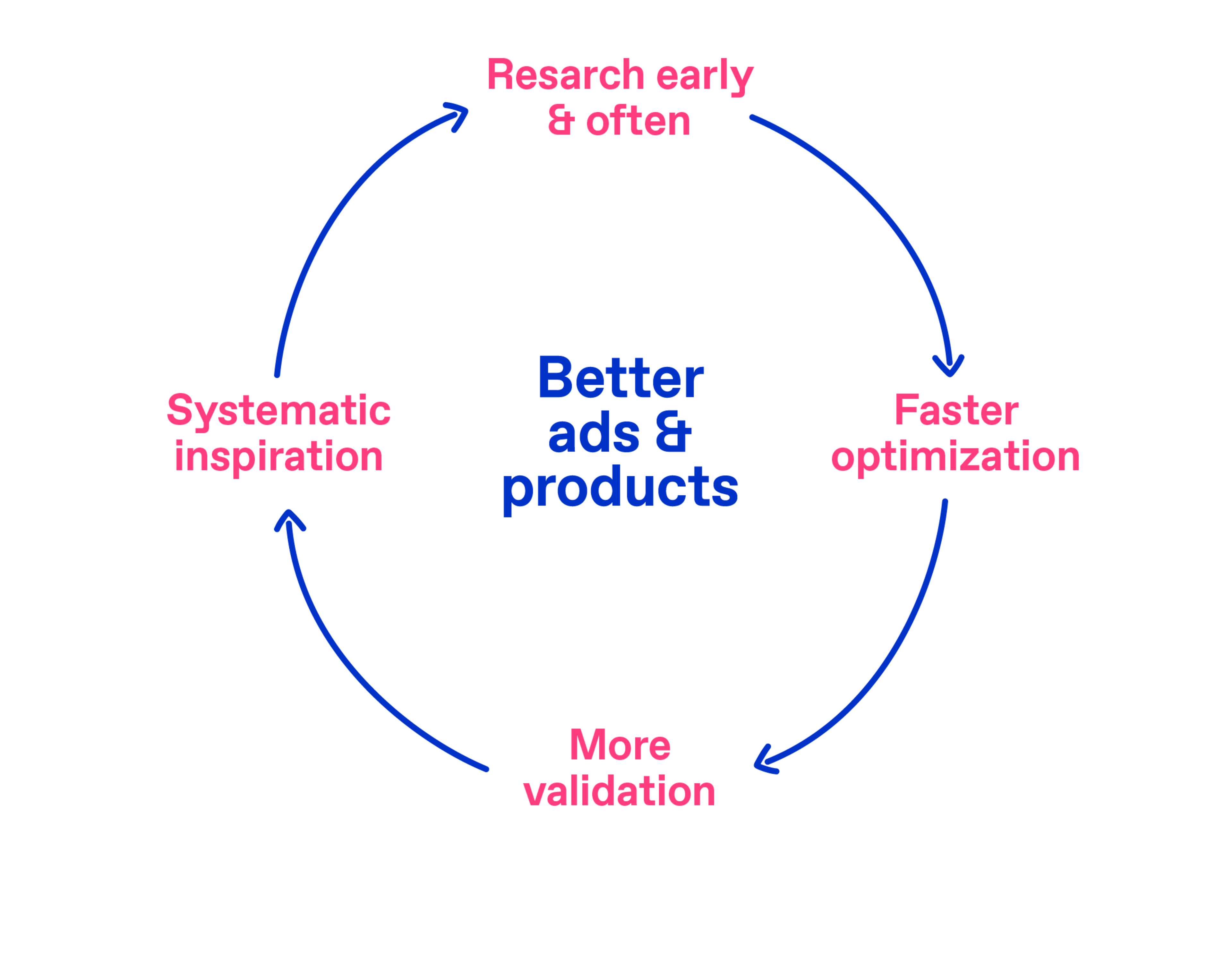
As we’ve covered here, the value of a connected insights platform isn't simply having research in one place. It's being able to connect what you've learned in the past with the decisions you're making today.
“I call that getting a head start. Why wouldn't you want a head start with all this knowledge that we had before? It's just going to make your outcome better.”
- Matt Cahill, Senior Director of Insights Activation, McDonald’s
That's what turns individual research projects into connected insights — and ultimately turns consumer research into something that becomes more valuable for brands over time.
Zappi’s connected consumer insights platform does just that, connecting consumer learnings across time so teams can build on previous research, complete with standardized frameworks and benchmarks that make results comparable with centralized access.
Learn more about our connected insights platform.
Consumer research shouldn't have an expiration date. When research is connected, every study can contribute to a larger body of consumer knowledge — helping teams spot patterns, make better decisions and learn faster.
That's the real opportunity behind connected insights.
With the right processes and technology, organizations can make every piece of research work harder and ensure that what they learn today helps them make smarter decisions in the future.
The Connected Insights Imperative report
To learn more about the value of connecting your insights, download our latest report.


